

What is Bloom’s taxonomy?
Bloom’s Taxonomy was originally developed by Benjamin Bloom an American psychologist in 1956. The model is used widely by educators at all levels and provides a framework for designing cognitive learning objectives to develop higher-order thinking skills in learners. The original Bloom’s Taxonomy was designed to foster cognitive development from lower-order thinking skills (knowledge, comprehension, application) to higher-order thinking skills (analysis, synthesis, and evaluation). This is commonly represented as a pyramid.
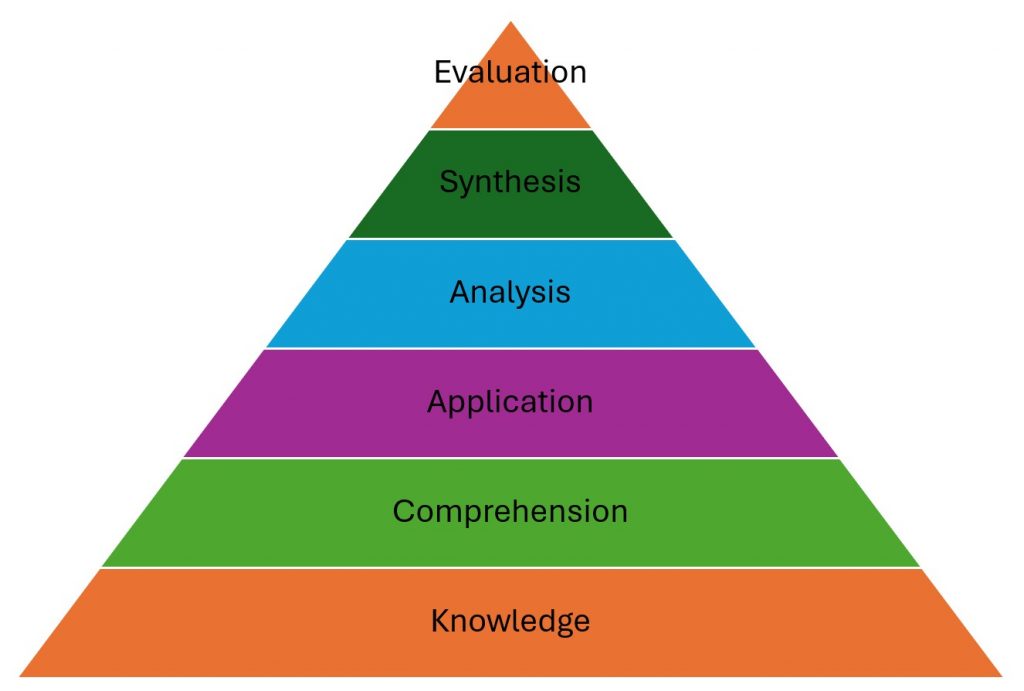
The original Bloom’s Taxonomy as described in (Bloom, 1956)
Bloom’s Taxonomy was later revised by Anderson and Krathwohl (2001) to include verbs instead of nouns at each level of knowledge within the pyramid (remember, understand, apply, analyse, evaluate, create). The use of verbs helps educators to create active learning objectives that describe what we want students to be able to do as a result of their learning.
Due to the growth in technology and online learning, the model was further developed by Andrew Churches as ‘Bloom’s Digital Taxonomy’ (2008) to reflect the growth of the digital era. The model represents the same categories as Anderson and Krathwohl’s version but includes digital technologies that can be used in each level of the taxonomy presenting and aligning higher-order thinking skills with the use of technology.
GenAI: a new era for Bloom’s taxonomy?
With the growth of AI, other researchers have sought to make further adaptations to Bloom’s idea. Hmoud and Ali (2024) have recently proposed a new model called AIEd Bloom’s Taxonomy. This model represents the use of AI for each layer from lower-order thinking skills to higher. The six layers of the model represent; collect, adapt, simulate, process, elevate, and innovate. The diagram below shows how these relate to the levels in Bloom’s Digital Taxonomy (Hmoud and Ali, 2024).
AIED Bloom’s Taxonomy Model
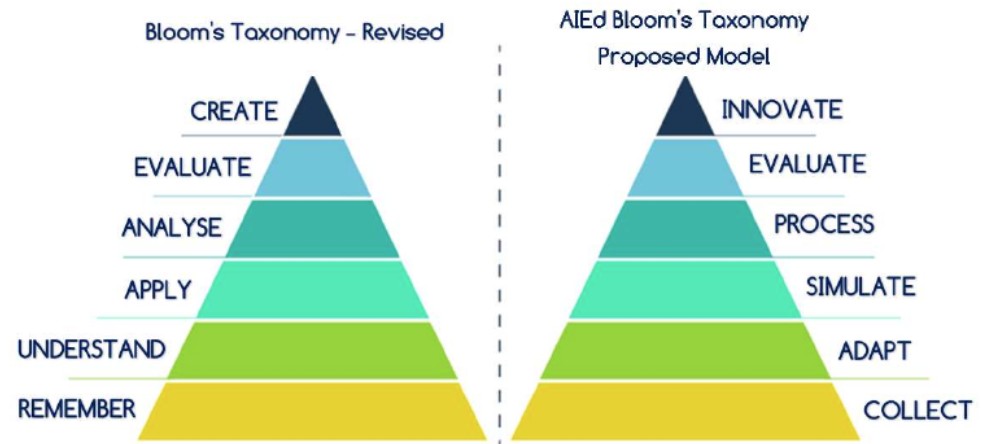
(Hmoud & Ali, 2024)
Application of AIED Bloom’s Taxonomy
Hmoud and Ali (2024) share how they applied the AIED Bloom’s taxonomy model to a unit of study called ‘photosynthesis’. The application of the model and its findings are presented on page 119 onwards (click here to view the article).
I have applied Bloom’s taxonomy when designing unit specifications for UG Business Management and in my seminar sessions. I find it a fantastic way to measure the growth of students’ learning in my classes.
Below is a table that represents how I would apply the AIEd Bloom’s taxonomy model. It refers to the learning outcome that I would set, activity I would design, and GenAI tools that I would use or encourage the students to use.
| AIED Taxonomy | Bloom’s Digital Taxonomy | Learning Outcomes | Activity | Gen AI tools |
| Collect | Remember | Identify each factor of PESTEL analysis. | Students take part in an online Quiz. | AI features in Kahoot designing the quiz. |
| Adapt | Understand | Discuss the strengths and weaknesses of using a PESTEL analysis. | Students use Copilot to help them form a discussion on strengths and weaknesses of using PESTEL analysis to understand the current conditions of the Marco environment. To present their discussion and justify the use of AI. | Copilot |
| Simulate | Apply | Apply a PESTEL analysis to a business of your choice. | Students apply for a PESTEL to a company of their choice using Copilot. Students will justify their use of Copilot. | Copilot |
| Process | Analyse | Analyse the variables found under each factor of the PESTEL. | Students to analyse the variable found for each PESTEL factor. Students use Copilot as a study buddy if needed. | Copilot |
| Evaluate | Evaluate | Evaluate each factor of PESTEL analysis against the opportunities and threats that it offers. | Students discuss the opportunities and threats that the PESTEL analysis has found via an AI discussion tool. | Parlay Genie |
| Innovate | Create | Design an artifact to present to the board on opportunities and threats that Marco environment currently presents with strategies to over them. | Students designing an artifact (video, infographic poster) for submission to the board members on the opportunities and threats that Marco Environment currently offers. | e.g. Canva Magic Studio. |
Bite-sized Task
In this activity, we will explore the AIEd Bloom’s Taxonomy model.
Step 1 – learn
Read the article by Hmoud and Ali (2024) to see how they have implemented their model to a unit on the topic of photosynthesis and view the example that I have provided to help generate some ideas on how you would apply the AIED Bloom’s taxonomy model to your own session.
Step 2 – do
Now that you have read the examples provided, you need to choose a topic of study approximating to one seminar session. Using the table provided below, design how you would include GenAI and apply the AIEd Bloom’s taxonomy referring to higher order thinking skills; process, evaluate and innovate. You could use all three or only one; it is up to you. For this activity you can use other GenAI tools, but it is important to remember that UoS encourages the use of Copilot.
| AIED Taxonomy | Blooms Taxonomy | Learning Outcomes | Activity | Gen AI tools |
| Process | Analyse | |||
| Evaluate | Evaluate | |||
| Innovate | Create |
Step 3 – reflect
Reflect on the following two questions and post your thoughts on the weekly team’s post.
- How would you apply the AIEd Bloom’s taxonomy model to a unit of study using Copilot as the main GenAI tool?
- Have you seen other variations or adaptations of Bloom’s Taxonomy? What Bloom’s taxonomy model would you prefer to use when using GenAI applications in your teaching and why?
Join in the conversation
Post your thoughts on the weekly Teams post to join the conversation.
Further links
Anderson, L. W., & Krathwohl, D. R. (2001). A Taxonomy for Learning, Teaching and Assessing: A Revision of Bloom’s Taxonomy of Educational Objectives: Complete Edition. New York: Longman.
Bloom, B.S. (1956). Taxonomy of Educational Objectives: The Classification of Educational Goals. London: Longman.
Churches, A. (2008) Bloom’s Digital Taxonomy. Available at: https://www.researchgate.net/publication/228381038_Bloom’s_Digital_Taxonomy (Accessed: 28 October 2025).
Hmoud, M., & Ali, S. (2024). AIED Bloom’s Taxonomy: A Proposed Model for Enhancing Educational Efficiency and Effectiveness in the Artificial Intelligence Era. The International Journal of Technologies in Learning, 31(2), 111–128. Available at: https://staff.najah.edu/media/published_research/2024/05/07/watermarked_aied-bloom-s-taxonomy_apr-26-2024-18-49-35_1.pdf (Accessed: 28 October 2025).
Kharbach, M., PhD. (2025, October 4). Using the Revised Bloom’s Taxonomy to Enhance AI Literacy – Educators Technology. Educators Technology.
Hierholzer, N. (2025, October 23). Using Bloom’s Taxonomy to understand AI Adoption in Higher Education. Online Learning Consortium. https://onlinelearningconsortium.org/olcinsights/2025/10/blooms-for-ai-adoption
Contributor biography
Sheena Bahra is a doctoral student at Anderson University in South Carolina, America studying EdD in Curriculum and Instructional leadership with a dissertation focusing on a GenAI Professional Development Program for Higher Education Instructors to encourage the use of GenAI for higher order thinking skills. She is a qualified instructional designer and educator. She is working on a project to develop AI literacy resources at the University of Southampton.