In collaboration with the People, Property, Community Research Centre at the University of Southampton, Home in Crisis is hosting a new book club focused on books, fiction and non-fiction, that explore the theme of ‘home’.
Each month we will meet on a Tuesday to talk about a book and have some lunch and every couple of months, we will meet after work and take our books to the pub.

The first book club meeting took place on Tuesday 17 March at 12.30 and we read Good Lord by Ella Frears. This book, written as one long email to a property manager, situates the home as a locus of precarity, tracing the emotional and material instabilities that define rented and shared living. The book’s speaker inhabits spaces that are never quite hers — rooms that belong to others, flats subdivided by financial necessity, rented homes from conveniently invisible landlords. The writing is extraordinary and Frears renders this condition with a sharp, often darkly comic eye: the indignities of tenancy (the permission required to hang a picture, the leak that goes unfixed, the housemates whose lives press uncomfortably close) accumulate into a portrait of adulthood in which the private sphere is perpetually compromised. The home, far from offering stability, becomes the site and source of crisis – the very ground on which vulnerability is most acutely felt.
Frears entangles the economic with the intimate. The pressures of expensive, insecure housing in contemporary Britain — the sense of being temporarily and barely tolerated in spaces one cannot truly claim — bleed into questions of selfhood, relationships, and bodily autonomy. The collection understands that the housing crisis is an interior experience: the body under strain in a home that offers no sanctuary, desire and domesticity twisted together in cramped and contingent circumstances. Frears writes the precarious tenancy as a psychic condition, one in which the instability of the external — the rolling contract, the unaffordable city, the shared bathroom — becomes inseparable from interior states of anxiety, longing, loneliness and the never met desire for home.
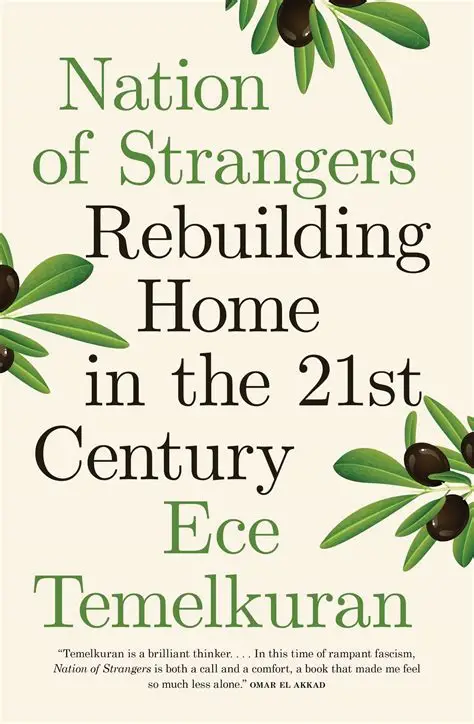
The second book club meeting took place on Tuesday 21 April and we read Nation of Strangers: Rebuilding Home in the 21st Century by Ece Temelkuran. This book draws on Temelkuran’s own experience of political exile to construct an argument about authoritarianism, belonging, displacement, and the condition of feeling unmoored from one’s homeland. Her project is in many ways urgent and necessary — she writes from a position of genuine loss, and her attempt to think across different forms of estrangement reflects a real political instinct about the connective tissue between authoritarian expulsion and the broader erosions of solidarity in contemporary life in contexts in which many thinks themselves immune to the arrived and on-the-horizan political, social and environmental crises. Yet the book’s central rhetorical move — the deployment of homelessness as a unifying metaphor for all those who feel they do not belong — begins to strain almost as soon as it is introduced. Temelkuran reaches for a vocabulary of displacement capacious enough to hold together the refugee forced onto a small boat, the rough sleeper in a European city, and the cosmopolitan intellectual displaced from home but received by Europe’s academic elites. Homelessness as metaphor does a kind of violence to the very people it nominally centres, dissolving material distinctions that matter enormously.
The problem is not that Temelkuran lacks compassion, but that the grammar of her extended metaphor flattens experiences of suffering and unhoming in ways that ultimately serve the more comfortable end of her spectrum. When homelessness becomes a feeling — an existential register of alienation available to the economically secure exile as much as to the person with nowhere to sleep — it risks aestheticising destitution and border violence rather than analysing them. The person on the small boat and the displaced but well-housed intellectual do not inhabit the same crisis, however productively one might wish to think across their situations. By stretching the metaphor of home and homelessness so far, Temelkuran centres the experience most like her own, and the book’s rhetorical universalism quietly narrows into something entirely self-referential.
Our next book is the Good Terrorist by Doris Lessing. We will be meeting on 13 May 2026. Contact us if you would like to join us.