

Work Package 6
Community death reporting and review
Rationale
More than half of neonatal deaths and a third of maternal deaths in sub-Saharan Africa occur outside of hospitals. The aim of this work package is to ensure completeness of data on deaths that happen outside health facilities (in communities or when patients are in transit to health facilities) by improving death notification and reporting in the community. We recognise that there are many modifiable factors in the community that can be addressed to prevent deaths, yet most death reviews take place in health facilities. Despite high mortality rates, there are no systems to provide families with bereavement care and support after maternal and/or perinatal deaths. We will co-design and evaluate a tailored community death notification and reporting, community death review and bereavement care and support building upon existing community health worker (CHW) systems in each country.
Work package 6 has four components:
We will
- Develop electronic tools/apps to support community death notification and train community health workers (or their equivalent) in Ghana, Uganda and Ethiopia on how to use the apps for reporting.
- Conduct qualitative interviews and focus group discussions with health workers, bereaved families and community leaders to understand the challenges that families face in relation to maternal and perinatal deaths. We will also explore opportunities for intervention by empowering community members to get involved in community MPDSR
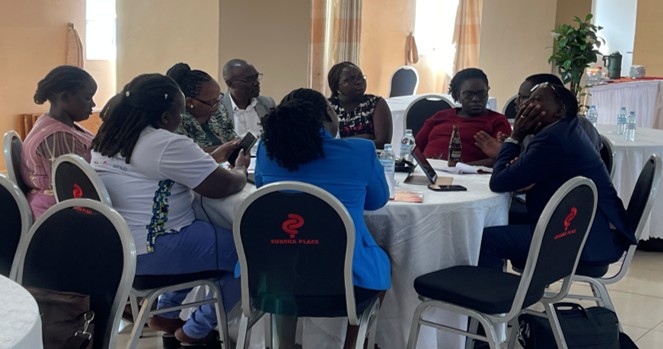
- Bring together stakeholders (health professionals, community leaders, bereaved families) to co-design tools for community death reporting and review and bereavement care and support.
Our work so far
Phase two- (October 2025-June 2026)
We have used the findings from the baseline qualitative research in phase one and feedback from co-design workshops with stakeholders (for the different work packages) to develop an ‘intervention toolbox.
We have developed four tools to improve community MPDSR drawing from the findings of baseline qualitative study and stakeholder engagement:
Community death notification forms
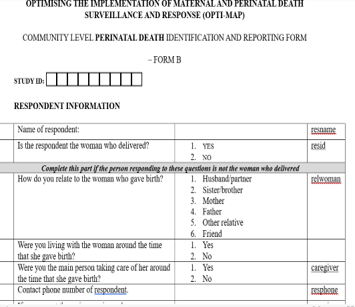
We adapted a community death reporting tool to address bottlenecks in death reporting. We developed the forms in paper, and as smartphone apps (ODK / eCHIS / Redcap) to collect data on maternal and perinatal deaths in the study sites. We worked with Health Extension Workers in Ethiopia, Community Health Volunteers in Ghana, and Community Health Extension Workers / Village Health Teams in Uganda. We have collected information on deaths since July 2025 to provide baseline data prior to the intervention.
Simplified verbal/social autopsy (VASA) forms for community health workers
we have adapted an existing VASA tool from Ethiopia to a shorter, user- friendly tool that community health extension workers (or their equivalent) can use to collect data from bereaved family members about the deceased’s symptoms and social circumstances before the death. This will be used to prepare a summary narrative of events that will be discussed in community death reviews.
A Community death review (CDR) training guide
The guide has been developed and adapted it to ensure that it is contextually relevant in each country. Training of CDR facilitators will begin in July 2026 once the intervention starts. We have sought the advice of CABs in each country in developing the CDR training guide and identifying appropriate people to train as CDR facilitators.
Bereavement care and support training guide
We will use the training guide to train bereavement care providers in each country. Each country will train different community actors based on feedback received from our baseline interviews and our consultations with CABs and other stakeholders. In each country, bereavement care providers will be people that bereaved families would feel comfortable sharing with- these include religious leaders, community health workers, village leaders.
Next steps
Phase 3: July 2026- June 2028
Objective: To evaluate the effectiveness and cost-effectiveness of implementing a customised “toolbox” of interventions to optimise MPDSR.
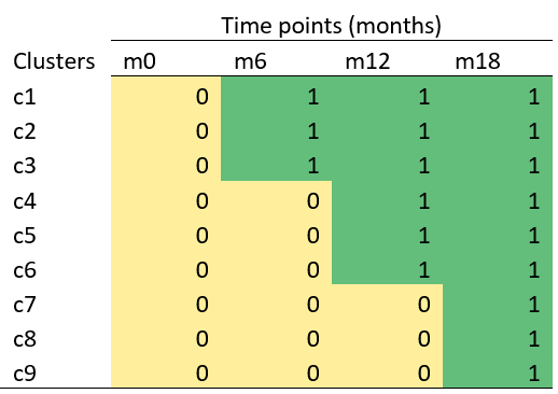
Design: Stepped-wedge cluster-randomised design
Participants: 3 Health districts in each country
Intervention: the “customised intervention package”
Comparison: standard care during control period
Composite Primary Outcome: Perinatal mortality rate – severe neonatal morbidity (Apgar score at 5 minutes of <7)
Primary outcome
The aim of the trial will to be able to detect 30% reduction from baseline in perinatal mortality rate (based on other studies of effect of MPDSR). Calculation based on baseline rates of perinatal mortality of 30 per 1000 (correct at the time the proposal was written)
To be able to detect a 30% reduction, from 30 to 21 per 1000 births, with an average cluster size of 1200 births per step (six months), we will randomise 9 clusters in three steps (excluding the baseline measurement) to achieve at least 83% power at a 0.05 level of significance assuming an intra-cluster correlation coefficient of 0.01. This is the most conservative estimate of ICC.
Secondary outcomes
- Stillbirth rate
- Institutional perinatal mortality rate
- Maternal mortality ratio
- Institutional maternal mortality ratio
- Institutional Maternal death notification rate
- Institutional Perinatal death notification rate
- Completeness of community maternal death notification
- Completeness of community perinatal death notification
- Maternal death institutional review rate
- Perinatal death institutional review rate
- Community death review rate
- Clinical record availability
- Quality of clinical records
- Level of implementation of MPDSR at facility level
- MPDSR committee training
- Accuracy of cause of death
- Completeness of avoidable factor identification
- SMARTness of recommendations
- Implementation of recommendations made at facility death review meetings
- Implementation of recommendations made at community death review meetings
- Bereavement counselling
- Costs
Leads

Dr Merlin Willcox

Dr Vincent Mubangizi

Kasiye Shiferaw

Tim Abagre