
Work Package 4
Human Resources: Training and exploring
institutionalisation of practice
Rationale
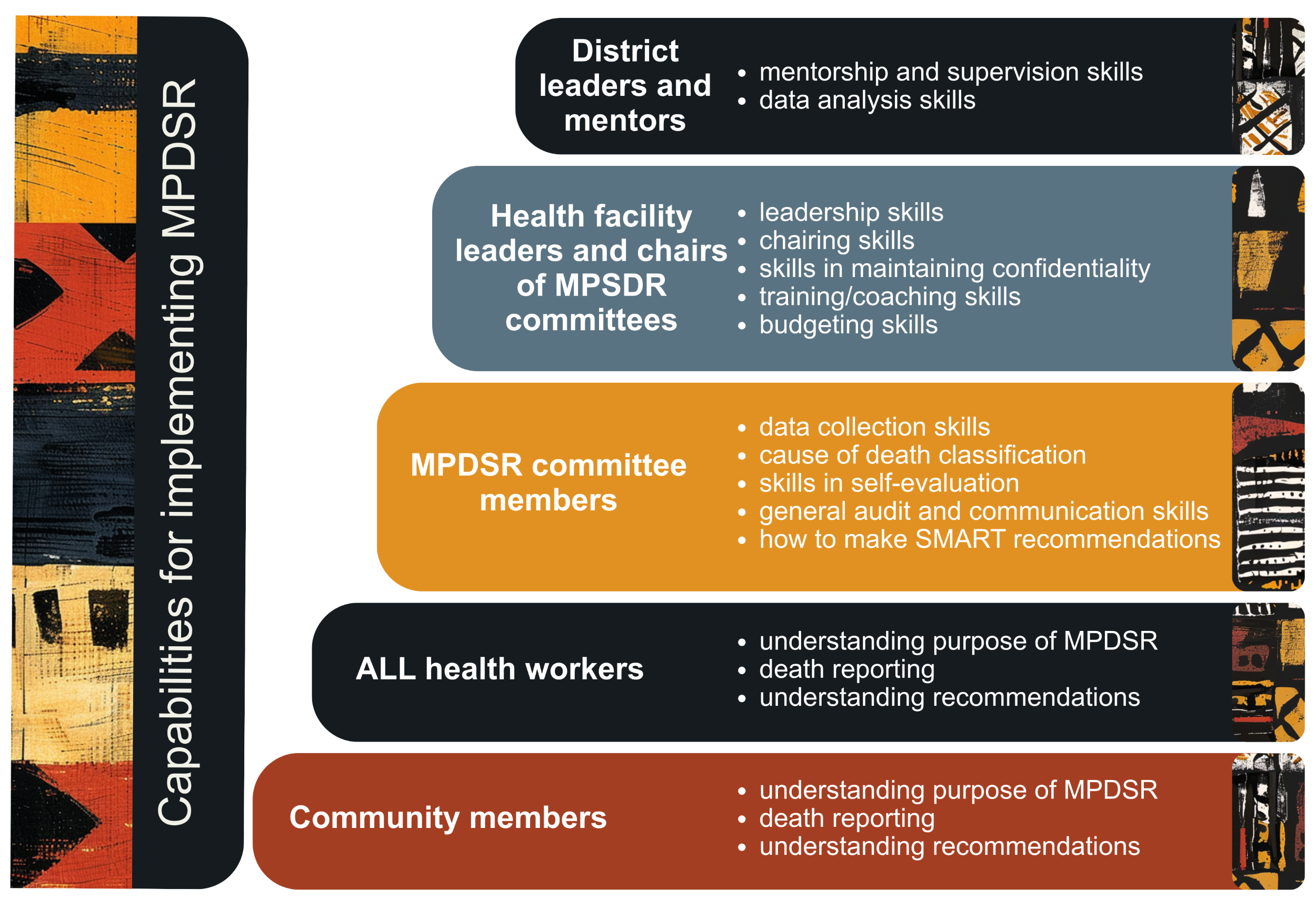
Effective implementation of MPDSR requires a range of capabilities for different stakeholders. It is unclear to what extent existing MPDSR training packages are effective at building these capabilities. There is a need to evaluate effectiveness for influencing behavioural determinants of MPDSR implementation, and then to improve existing materials or develop new materials where these do not exist.
A key factor in enabling a “learning environment” is to ensure psychological safety of participants. If healthcare teams have psychological safety, employees feel safe in sharing opinions, ask questions and with no negative repercussions when they report a mistake. Such a climate facilitates speaking up, where mistakes are seen as learning opportunities, and differing opinions constitute challenges rather than lead to blame, shame, and punishment. It means that healthcare workers need to take “risks” (e.g. in speaking up) in order to ensure patient safety. Psychological safety allows health care professionals to take the interpersonal risks needed to engage in effective teamwork and to maintain patient safety.
We will
- enable institutionalisation of MPDSR into routine practice through pre-service training, ongoing CPD and mentoring.
- review existing training courses for all levels of health workers and stakeholders, and how well they address the requisite capabilities.
- evaluate and optimise existing courses for the specific contexts of Ethiopia, Ghana and Uganda.
- co-design and evaluate courses for specific stakeholders where these do not already exist.
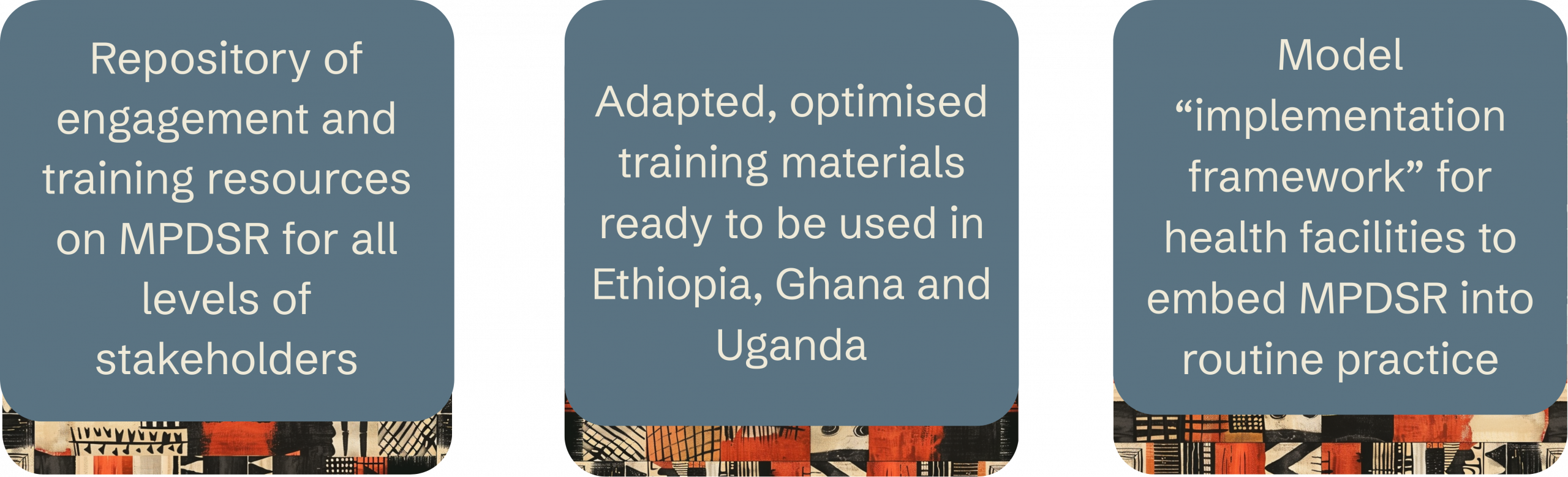
Deliverables
Our work so far
Our baseline interviews helped to map existing skills of members of MPDSR committees and identify missing competencies that are necessary to support effective MPDSR sessions. We have developed a suite of training materials:
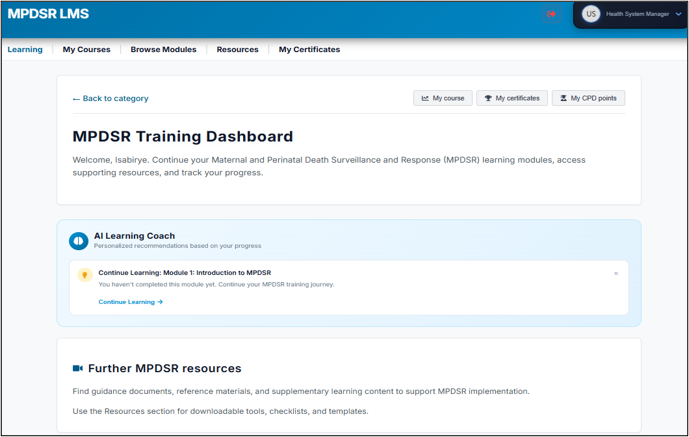
MPDSR e-Learning
an e-learning platform providing free, self-paced competency-based MPDSR training. There are nine e-learning modules that use interactive case scenarios and automated quizzes to motivate learning. Users can track their progress and get certificates upon completion.
Dedicated online platform for health professionals in LMICs(https://learnmpdsr.org/)
Free, self-paced, competency-based MPDSR training
Hosts interactive modules, job aids, case scenarios, and automated quizzes
Tracks progress and issues certificates and CPD points upon completion
Sources of Information
- WHO: MPDSR technical guidance, ICD-MM, ICD-11, ICD-PM, Three Delays Model
- USAID Momentum: Training and implementation materials on death reviews
- Country specific National MPDSR guidelines
- Peer-reviewed literature: CHAMPS study, QUARITE trial, country-specific success stories
3-day Face-to-Face MPDSR Training
training materials for face-to-face learning, after users have completed the e-learning modules. Face-to-face training involves skills lab (e.g. taking quality minutes of MPDSR sessions) and role plays.
| Session | Intended competencies |
|---|---|
| Registration, pre-test review, welcome | Settle in; establish baseline knowledge |
| Role Play 1: Forming committees & code of conduct | Establish psychological safety; assign team roles; draft and sign a code of conduct |
| Role Play 2: Maternal death review | Apply Three Delays Model; identify modifiable factors, Formulate SMART recommendations linked to root causes |
| Role Play 3: Perinatal death review | Distinguish fresh vs. macerated stillbirth, Classify neonatal death using ICD-11 |
| Hands-on: eMPDSR application | Navigate the platform; understand case entry workflow, Enter complete review findings; use dashboard to track recommendations. |
| Role Play 4: Chairing difficult meetings | Reframe blame statements into systems inquiry; manage dominant voices |
| Skills Lab: Minute-taking | Translate heated discussion into objective minutes with trackable action items |
| Role Play 5: Dysfunctional team dynamics | Diagnose root causes of poor team function; practice solutions |
| Bereavement Care : Communicating bad news | Act without delay; use private space; say “Your baby has died”; avoid harmful phrases |
| Bereavement Care: Going home (preparing families) | Check bleeding, BP, urination; teach danger signs; arrange follow-up |
| Bereavement Care: Self-care for health workers | Recognise compassion fatigue; debrief after deaths; use peer support and counselling services |
| Group Action Planning | Complete Action Plan with assigned responsibilities and deadlines |
| Post-test & workshop evaluation | Demonstrate knowledge gain; provide feedback on training |
Leads

Dr Charles Ameh