by Grace Rymell
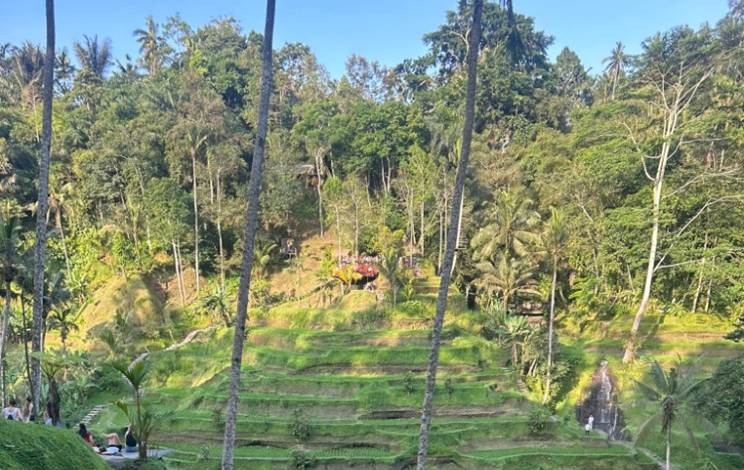
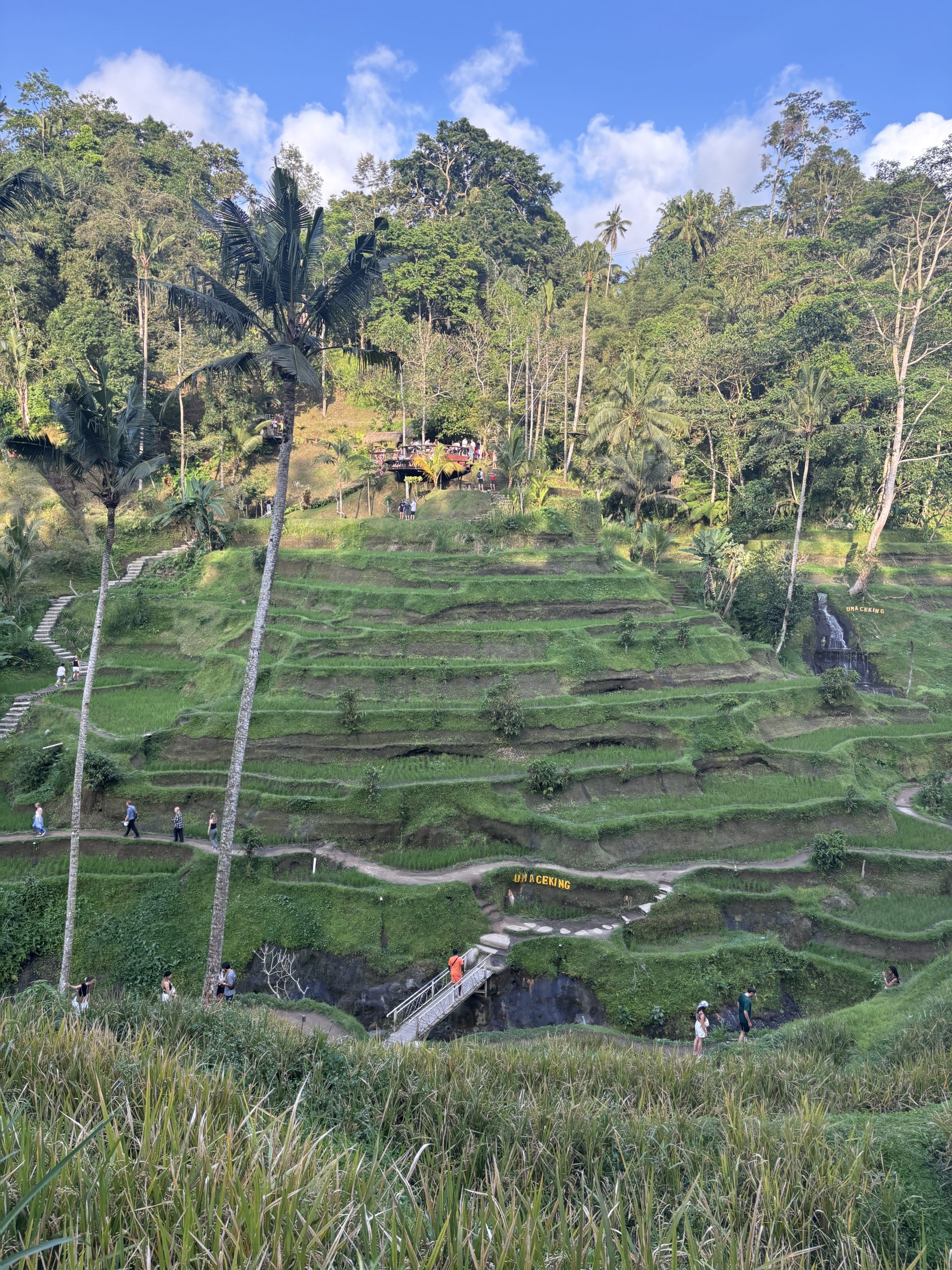
Ubud’s Tegalalang Rice Terrace Now Acts as A Tourist Hotspot. Captured by Author
Introduction
The Indonesian Island of Bali is globally renowned for its breathtaking scenery. None of this scenery is more recognisable than the island’s beautiful, cascading rice terraces. These rice terraces hold significance that extends far beyond their beauty, as key parts of the island’s farming practices known as Subak that sustain and unite communities. The rice terraces and the practice, Subak, that comes along with them are under significant threat as a consequence of the commercialisation of productive lands to house the masses of tourists that flock to the island each year. Whilst the law recognises the importance of the practice and the need for the island’s tourist influx to be managed in a sustainable way, it does little to effect actual change to slow or prevent Subak’s decline. The losses of Subak exist in two different forms, visible and invisible. The visible harms, stemming from a loss of nature and the impact this has on the island’s ability to cope with its tropical climate and the invisible harms from the drastic shift in people’s lived experiences and relationship with their homeland.
Understanding the Practice of Subak
The practice of Subak, formed in the 9th Century, ensures available water travels to local villages and is equitably distributed amongst the villagers’ farmland. This practice was formulated out of an island-wide need to ensure successful harvests, as Bali has a dense population and variable levels of water availability. The practice provides an excellent example of sustainable farming as through the practice Bali grew to become the most prolific rice growers in the archipelago, crafting a system that works with nature rather than fights against it.
Outside of Subak’s physical significance, the practice is deeply embedded within the community and religion, that makes up Balinese culture. The practice is recognised by UNESCO as a cultural heritage treasure. The community, fostered by the need for farmers to work together, led to development of customary laws called Awig-Awig, which are protected under codified Balinese legislation. In addition to the community cooperation element of Subak, the practice is entwined with philosophical and religious beliefs. The Balinese Hindu philosophy of Tri Hita Karana, translating to three causes of prosperity, combines God, people and nature instils the importance of harmony, cooperation and conservation.
The Decline of Subak
Within the last two decades the Subak system has been placed in jeopardy. The island has undergone rapid changes to its landscape through industrialisation and commercialisation to accommodate for the masses of tourists that visit each year. This landscape alteration has upset balance that Subak and the philosophy of Tri Hita Karana created between God, people and nature.
In 2012 Provincial Decrees of Bali set out to recognise the importance of Subak and integrate cultural respect and sustainability into the island’s tourism, putting legislation in place to protect Awig-Awig, productive land and embed philosophies of Tri Hita Karana. However, this recognition has not secured the land and conditions needed for the practice to survive, largely because enforcement remains weak. This weak enforcement is not simply an oversight: authority over Subak itself rests with customary, village-level bodies, while the power to approve land-use permits sits with district and provincial governments, whose budgets and priorities are heavily shaped by tourism revenue. The bodies best placed to restrict harmful development are therefore also among the most financially invested in allowing it. This has reportedly contributed to losses of around 1,000 hectares of green or agricultural land each year.
It is worth being clear that tourism is not straightforwardly a harmful force imposed on the island. Tourism is estimated to be central to a large share of Bali’s economy, supporting employment across the island, including for many who have left farming. For a number of Balinese families, tourism-linked work has provided a more financially stable livelihood than smallholder farming alone could offer. The harm explored in this piece comes less from tourism as an industry and more from a largely unregulated model of land conversion, one whose profits often accrue to investors and operators from outside Bali, rather than to the communities that bear its environmental costs.
Flooding Experienced in Canggu Source: Captured by Author
The Physical Impacts of the Loss of Subak
Due to the failings of legislators, it was foreseeable that the island would feel the impacts of the decline of Subak. In 2025 the island was met with heavy rainfall, volumes of which are to be expected in a tropical climate. However, the island found itself poorly equipped to absorb the excess water, as productive land and volcanic soil had been replaced with tarmacked roads and hotels. Many densely populated areas were heavily flooded, resulting in at least 18 people losing their lives. These deaths included a number of tourists, capturing significant international media attention and prompting environmental groups to link the island’s rapid industrialisation with its inability to deal with the climate’s natural weather cycles.
Such loss, combined with widespread international media attention, led to Indonesian governors rapidly taking action on the implementation of strict building regulation. This included reinstating a moratorium on further commercial building on productive lands in six major areas including Tabanan the home of UNESCO protected rice terraces. Notably, such bans are weak in their effect, failing to put restrictions in place in the most densely populated tourist areas of the island, including Canggu, Seminyak and Denpasar, the island’s capital. Whilst the circumstances that acted as the vector for this ban’s implementation are undoubtedly tragic, one must look toward the future, in hopes that a properly enforced ban in some vulnerable areas, will at least halt Subak’s decline.
However, the legal status and extent of this ban do not inspire much confidence that this legislation will provide sufficient protection. The ban’s durability remains uncertain because it was introduced as an executive policy directive, rather than being placed on a statutory footing, meaning it can easily be reversed. This has been recognised by construction companies, who are already counting on its swift repeal and drawing attention to its failure to restrict purchase of land, meaning acquisitions can still go ahead. The ban’s sincerity is also undermined by excluding the places that are most prolific for commercial construction. This mirrors the same structural conflict of interest underlying the 2012 decrees: the same governments responsible for restricting harmful development also rely on the revenue that development brings. This demonstrates the failures of reactive laws, responding to harms without effectively tackling their causes.
The Human Impacts of the Loss of Subak
The physical impacts of the loss of Subak are severe. Loss of life and land are tragic, but at least they are visible and capable of attracting attention to the decline of Balinese green spaces. However, there is an invisible harm occurring to the Balinese people alongside this. For a culture that places the Tri Hita Karana, a balance between community, God and nature at its core, watching the island evolve to lose this harmony in favour of pursuing economic gain has complex psychological impacts. Whilst the harm is not quantifiable, it can be explored through the philosophical concept of solastalgia, meaning to no longer derive solace or comfort from a familiar environment, such a concept can be experienced uniquely based on the lived experience and relationship with the island, or lack thereof, that comes from being born of different generations. This inequality in experience and contribution to the loss of Subak gives rise to intergenerational injustice.
It is worth noting that solastalgia, as originally conceived, describes a gradual, cumulative form of distress caused by slow-moving environmental degradation, most commonly studied in contexts such as mining landscapes. Bali’s experience does not map neatly onto this single, chronic form alone: locals appear to carry a slow-building distress from two decades of land conversion, alongside a more acute distress tied to the sudden trauma of the 2025 floods, and, for some, an anticipatory distress about further loss still to come. These forms likely compound one another rather than existing in isolation, suggesting that solastalgia as a single, static concept may not fully capture the layered and evolving nature of the harm being experienced here.
Older generations of Balinese most deeply feel the impacts of the island’s changes in nature, through the traditional definition of solastalgia. Many locals have vocalised their lived experiences of watching their environment change as tourism has increased. They have watched the productive lands that, simultaneously, sustained and were sustained by their ancestors be turned into something they often no longer recognise. Due to the decline in opportunities to practice Subak, locals have been forced into the services sector, competing for tourists’ business to make a living. This stands in stark contrast to the community efforts the island once knew, harming the philosophical beliefs that instilled togetherness and harmony. As a result, the island the elders once knew has changed beyond what many feel able to recognise, creating profound losses in the ability to recognise and find comfort in the world around them.
Moreover, elders who exist in isolated areas where Subak continues to be practiced and preserved risk feeling a sense of anticipatory- solastalgia, a term referring to the feeling of anxiety in anticipation of losing familiar environments. Despite the increased legislation to preserve Subak, it is notably weak and fragile. Remaining communities may feel it only a matter of time until developers set their sights on the next area of green space to be economically exploited. Elders may also feel anticipatory solastalgia for the knowledge that their children or grandchildren will be disinterested in practicing Subak and in being a member of a harmonious community, in favour of the more stable salaried income provided by entering the services sector. This, in time, adds to the loss of the cultural practices that they have grown up surrounded by.
The younger Balinese generations may feel a sense of injustice due to decisions of older generations, depriving them of a significant autonomy. Whilst large portions of the population were victims of weak legislative protection leaving them no choice but to enter the services sector. Elder generations had the ability to learn of Subak from the generations before them, unlike younger Balinese, who were left without the option to ever truly learn Subak, a practice so key to feeling connected to their culture and environment. These individuals may have spent their early childhoods surrounded by the communities and harmony Subak provided, only to be met with a completely different environment by the time they reached an age where they could truly engage with it. Thus, experiencing solastalgia in a unique way, through a feeling of helpless detachment from their surroundings. This is intergenerational injustice, experienced through a lack of autonomy, where decisions made by earlier generations have taken away the opportunity from younger generations to ever truly feel the same sense of Tri Hita Karana that their ancestors knew and being frustrated at being left to deal with the long-term effects of the physical changes to the island.
The next generation of Balinese are set to experience the most intense form of intergenerational injustice, being born into a culture increasingly dependent on tourism, with the traditional practices that allowed the island to exist self-sufficiently being placed at serious risk. This generation has fewer opportunities to experience Subak as a living community practice rather than as heritage displayed for tourism, with some young people increasingly drawn into tourism-dependent service work. Those privileged enough to be able to learn of the island’s deep history and culture will likely feel distressed at the way their environment has changed in such a short time. These young people, if they choose to immerse themselves in the religious practice that remains, may feel distress at how their lived experiences feel so far detached from their beliefs rooted in Tri Hita Karana and Subak. These generations may struggle to feel truly connected to their home and heritage. Looking to the future, such detachment risks resulting in a loss of passion from communities in the fight to maintain or restore traditional culture.
Conclusion
The failures in the law to protect the Balinese practice of Subak against rampant industrialisation and commercialisation to accommodate tourists, has had a profound impact upon both physical integrity of the island and those who call Bali home. However, attention is only often paid to the physical damages, due to their greater visibility through measurable losses of land and the increased frequency of natural disaster. Many fail to consider the distress caused to the Balinese through the rapidly changing landscape, upsetting the harmony that the locals felt toward the land propped up by philosophical beliefs of the Tri Hita Karana and the deep sense of injustice uniquely experienced by different generations of Balinese people. Looking toward the future, protecting what remains of Subak and its surrounding culture requires proactive codified legislation that puts an end to both the acquisition of and building on productive land. As tourism has become such an essential part of the Balinese economy, with a significant portion of the workforce being reliant on the income that it brings, future initiatives must look to integrate and enforce culturally respectful, sustainable tourism practices that channel more of tourism’s economic benefit back into the communities and land it depends on. Whilst experiences of solastalgia have already begun, feelings of anticipatory solastalgia may be mitigated if legislators show genuine efforts to restore the balance of Tri Hita Karana. They could do this by creating initiatives which afford the next generation the opportunity to engage with Subak, the success of such initiatives would require education on its practice and importance as well as demonstrating its ability to reap financial benefits rivalling those of entering the tourist industry.
Grace Rymell is a law graduate from the University of Southampton. During this time Grace has travelled to Asia to represent the University in contract negotiation competitions. She has gained practical legal experience across commercial and care law, as well as through volunteering at a legal clinic. Grace is currently undertaking the SQE alongside an LLM at the University of Law.