

Prof. Craig Lambert’s keynote lecture at a conference of the The British Commission for Maritime History
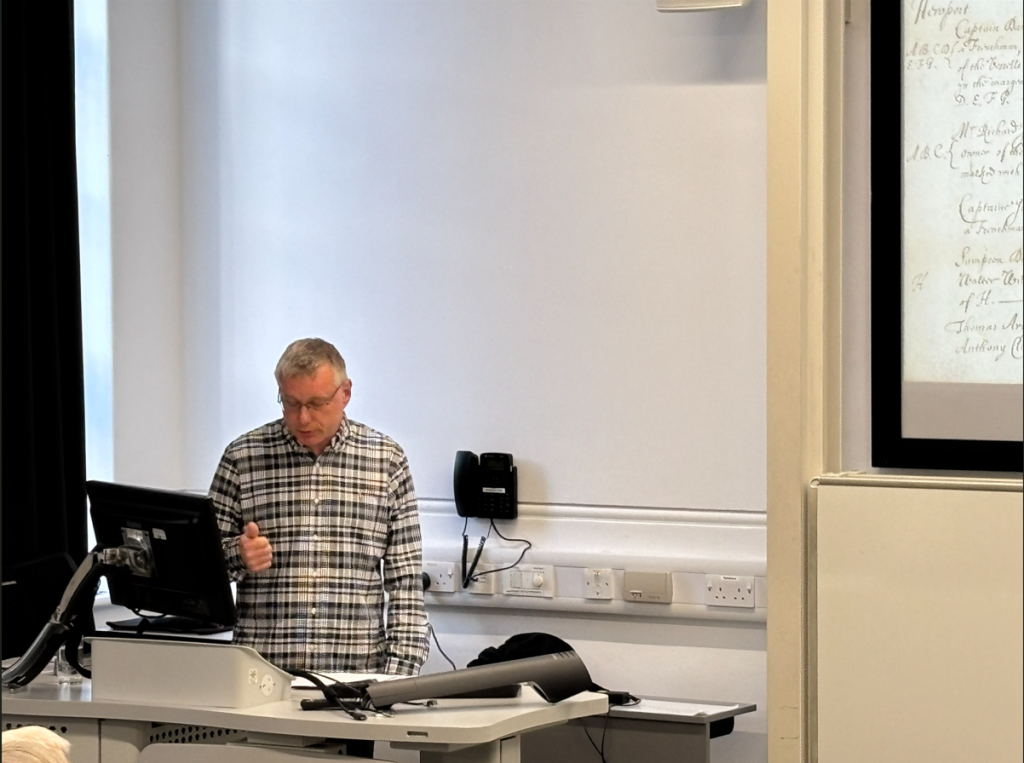
On the 17-18th April we were proud to host The British Commission for Maritime History at the University of Southampton for their 31st ‘New Researchers in Maritime History’ Conference. This was organised by BCMH and Prof. Helen Farr (Archaeology), a trustee of the Commission, and supported by the Society for Nautical Research, the World Ship Society and Boydell & Brewer publishers.
The conference commenced with an excellent keynote lecture given by Prof. Craig Lambert. The keynote drew on his work as Principal Investigator of the Maritime Britain project. The lecture argued for a fundamental shift in how we understand early modern England: not as a land-based kingdom with a coastline, but as a society structured through maritime movement.
Using large-scale analysis of port books, customs accounts, and ship surveys, Prof. Lambert explored how England’s maritime world functioned as an interconnected system. Rather than a London-dominated hierarchy, the sixteenth century reveals a regionally structured network, with the East and South West playing leading roles. Crucially, coastal trade, often overlooked, formed the backbone of this system, accounting for around three-quarters of recorded voyages and underpinning overseas expansion.
By linking datasets, the project moves between scales: from national patterns of shipping and trade to the lives of individual mariners, merchants, and shipowners. This allows us to see maritime Britain not only as an infrastructure, but as a lived social world shaped by labour, risk, and opportunity.
The central takeaway is simple but important: the sea was not peripheral to early modern England—it was one of the main ways the country functioned.
The following day showcased a range of excellent cross-disciplinary maritime research by ECRs from across the UK, and as far afield as Ontario, Canada. These covered a range of topics from Royal Naval Hammocks to submarine technology, naval strategy, censorship and the secret service, maritime communities and maritime disasters (of course, being Southampton, there was a Titanic paper!), and intangible cultural heritage, coastal community and craft- from the UK to Antarctica. A special mention goes to Southampton’s Dr Felix Pedrotti (Engineering/ SMMI) who turned up with a large towing tank model to illustrate the hydrodynamics of the RRS Discovery in the afternoon session on Antarctic exploration.
The conference was well attended by participants from a range of institutions and backgrounds at various stages in their career, including academic and independent researchers and maritime stakeholders, fostering a supportive environment for ECRs to chat and network.
Current developments in maritime technology, sustainability and connectivity in the UK are as much a product of their historical trajectory and heritage as they are our island status and nautical architectural or marine engineering capacity. Understanding the nuance of these historical developments through the study of maritime histories can give us a unique insight into the trajectory of this development and the direction we are headed; this overtly historical research transcended academic disciplines and stakeholders, encompassing themes of past maritime security, trade, technology, craft and heritage and its relevance to present day.