

Contested ideals of translation in the early Sino-European Canton trade, 1550–1650, by Dr Jacob Fordham
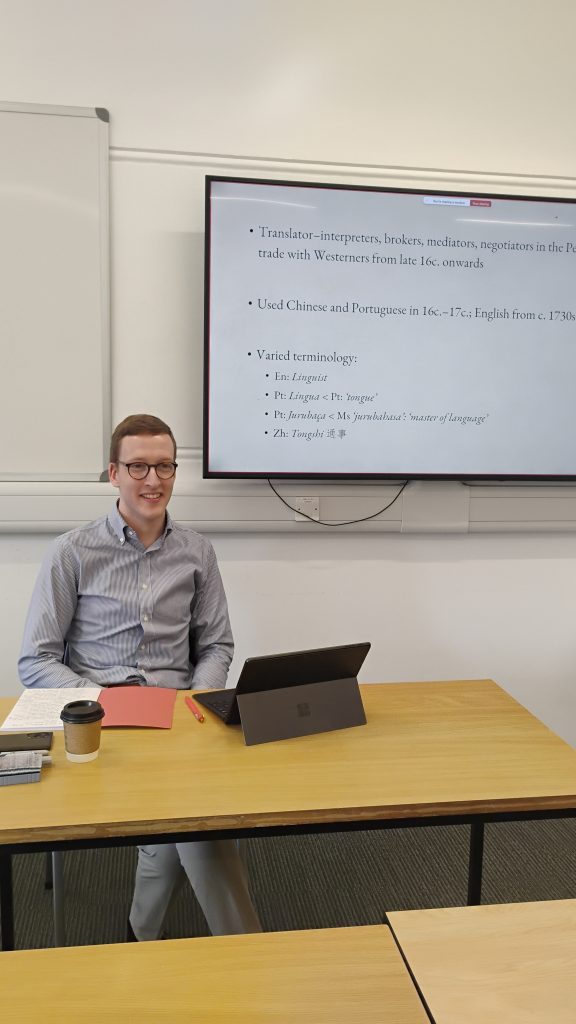
This week, Dr Jacob Fordham (London School of Economics) gave a brilliant talk about translations and translators in the context of trade in south China in the 16th and 17th centuries. He asked: How can we write the history of translators known only elusively through the judgements of others? Can we historicise the terms by which we judge translation? The Pearl River Delta ‘linguists’ (通事 or jurubaças), translator-interpreters between Chinese and Portuguese trained in Macau and Canton, were the primary linguistic and commercial mediators of early modern trade between China and Europeans. Yet we know of them primarily through condemnations of them in an archive formed of judicial and commercial disputes. The burden of nineteenth- and twentieth-century scholarship, as well the modern ideal of the neutral and disinterested translator, have meant that they have often been understood anachronistically as corrupt and self-serving, a subversive problem to be solved. Dr Fordham suggested an alternative reading set against the backdrop of a wider debate over public interest and office, and of the ethical value of private interest and the pursuit of profit. The linguists were framed through a language alien to modern translation theory, inseparable from human agency and motives. Understanding early modern translation by its own standards in this way pushes us to rethink the terms of early Sino-Western entanglements.
You can read more about his work here: https://ora.ox.ac.uk/objects/uuid:a330f561-4bc7-481a-98ab-6cf9c0ccf2eb