

A talk by Dina Lupin at the University of Southampton Faculty of Social Sciences Research Away Day
Interdisciplinarity comes in many different forms and shapes but today, for the sake of making a point, I am going to divide all of it into two categories: modest interdisciplinarity, which is fine if modesty is your thing, and ambitious interdisciplinarity which I am going to argue is the only thing standing between us and existential collapse, kind of.
Modest Interdisciplinarity
For many scholars who engage with interdisciplinarity, what they are seeking to do is look to other disciplines to try and find new tools to answer questions or describe problems that come up in their own discipline. For example, a political scientist studying how ideologies spread through populations borrows the concept of “contagion” and epidemiological modelling from public health. The question is about political behaviour, but the framework for describing it comes from a completely different field. Or an economist who finds that standard utility models can’t adequately describe why people make seemingly irrational choices and turns to phenomenology or philosophy of mind to find better conceptual vocabulary for describing human motivation.
What is common to these modest cases of interdisciplinarity is that the question stays at home in its discipline, but the tools travel. The scholar isn’t becoming an epidemiologist or philosopher; they’re raiding another discipline’s toolkit to better describe or even solve a problem their own discipline couldn’t crack on its own.
I want to emphasize that I think this is good and useful, although vulnerable to a number of possible weaknesses. For one, this kind of interdisciplinarity is often done by one scholar, looking from their home discipline and this kind of interdisciplinary borrowing can result in weak academic practice as a result of a misunderstanding or misrepresentation of the borrowed disciplinary tools. Often what we see is that each discipline treats the others as locked in time, drawing only on the original or the most famous accounts of something and failing to engage with the nuanced and complex ways theories and methods develop within a field.
And the reason why interdisciplinarity is vulnerable to this kind poor academic practice is because it is, actually, an incredibly difficult thing to do. We are not renaissance men, experts in physics, and art and philosophy and politics (and using this array of skills to keep women oppressed or to justify slavery). Even the generalists among us are deeply narrow in their research focus. While our disciplines are sometimes concerned with common themes (we might all be working on climate change or AI for example) we lack shared understanding of what counts as knowledge, as research, we have limited shared conceptual resources, we have different epistemological commitments, different methodological conventions, different standards of evidence and reproducibility, we cannot argue with each other because we disagree about what counts as a good argument.
These differences are not trivial, they are profound and, while getting past them demands patience and intellectual humility and a willingness to be a novice again, this is challenging because it requires us to learn and think in ways we are not trained for. It is also challenging because disciplinary identity runs deep. It has taken me twenty years to own this in public, but I am a lawyer and I don’t mean professionally, I mean in my soul – culturally, cognitively. It shapes so much of my life, it’s the books I read and the music I listen to, it’s the way I write and the things I am interested in. It is, my teenage daughter will tell you, the way I parent even.
Ambitious Interdisciplinarity
So if modest interdisciplinarity — the borrowing of tools across disciplinary lines — is already this hard, why am I about to make a punt for something more ambitious?
Well because, I think that ambitious interdisciplinarity helps us overcome the problems of its more modest sibling and because I think we can achieve things with an ambitious approach that otherwise aren’t available to us, like saving the world from almost certain demise.
First saving the world: the problems we face don’t care about our disciplinary identities. Climate change doesn’t stop at the border between environmental science and political theory. The rise of authoritarian governance isn’t waiting for political scientists and sociologists and legal scholars to agree on a shared methodology before it gets worse. Artificial intelligence is reshaping labour markets, warfare, intimacy, epistemology itself — and it is doing all of this simultaneously, at speed, without asking whether we have the institutional structures to respond. These are not disciplinary problems wearing interdisciplinary clothing. They are genuinely, structurally, irreducibly complex problems that require complex solutions. And complex solutions require something more than one scholar raiding another discipline’s toolkit. They require us to build something together that none of us could have built alone.
How can interdisciplinarity enable us to do that?
Well, ambitious interdisciplinarity gives us better answers. When we bring together people who think differently, who have different standards of evidence and different methodological instincts and different conceptual resources, and when we genuinely collaborate — not just cite each other— we get closer to solutions that are adequate to the scale of the problems we’re facing. A climate policy that is technically sound but politically naive will fail. A governance framework for AI that understands the technology but not the history of how powerful institutions capture regulatory processes will fail. A public health intervention designed without understanding the cultural and economic context in which people make decisions about their bodies will fail. The complexity of our problems demands a corresponding complexity in our responses, and that complexity cannot live inside one person, or one discipline.
But, more importantly, ambitious interdisciplinarity doesn’t just give us better tools for answering our existing questions. It gives us entirely new questions. And right now, we need new questions urgently. Interdisciplinary collaboration doesn’t just add knowledge, it has the capacity to transform our ways of knowing and thinking and being our disciplines. It surfaces the questions we didn’t know we weren’t asking. It is this transformation that the best interdisciplinary research achieves — and that purely disciplinary or even modest interdisciplinary research, however excellent, cannot.
(And if you are lucky enough to have a historian in the room, they will tell you that your new question is actually an old question.)
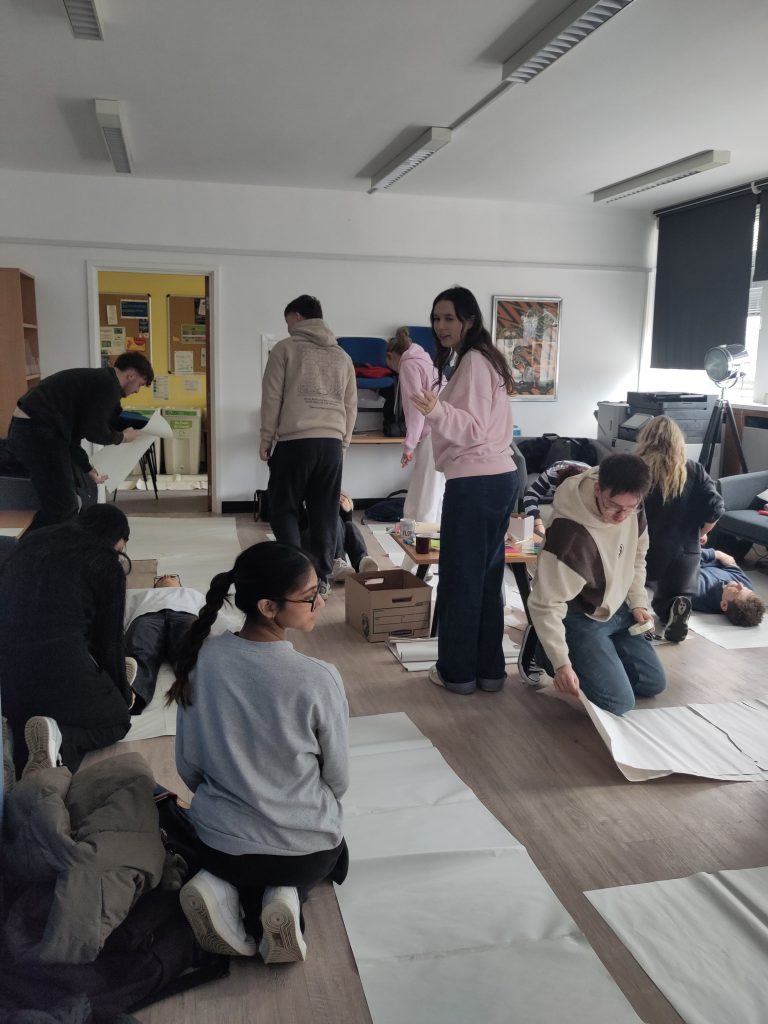
But the thing that makes ambitious interdisciplinarity fundamentally different from the modest kind is you cannot do it alone. Ambitious interdisciplinarity is a group action. You have to meet together, work together, think together, learn together and write together. It requires you to be in a relationship with people who think differently from you — not just occasionally, not just at a workshop where you each give your own presentation and then have dinner, but in sustained, difficult, genuinely mutual intellectual partnership. The kind of collaboration where you cannot always tell, at the end, whose idea it was. The kind where you have had to explain yourself so many times, from the ground up, that you have started to question things you thought were settled. The kind that makes you a better scholar in your own discipline.
To do this kind of research we have to be willing and humble and interested, we have to trust each other but, more fundamentally, we have to know each other. We need to meet each other.
This could be much better fostered by the structures that currently govern academic life. Our journals are disciplinary. Our departments are disciplinary. Even our buildings, in many institutions, are disciplinary — the lawyers are on the third floor and the sociologists are across the road and the artists are in a different postcode and we can work together in the same institution, often in the same faculty for years without even encountering each other.
So what do we actually need to do?
We need to keep investing in and incentivising the infrastructure of encounter. The conditions under which genuine intellectual collaboration happens are specific and they don’t arise by accident. They require sustained time together — not a seminar series, not a reading group that meets four times and then dissolves, but multi-year research partnerships with real resources attached to them. They require physical and institutional spaces that are not owned by any single discipline. They require funding mechanisms that support the slow, inefficient, uncertain early stages of collaborative work before it has produced anything that looks like an output.
To do this kind of research we have to be willing, humble and interested, we have to trust each other. More fundamentally, we need to meet each other. We need to keep investing in the infrastructure of encounter.
I know we are here to talk about research, but I am going to make a punt for interdisciplinary teaching as a key part of this. The moment at which disciplinary identity hardens is not the PhD. It is the undergraduate degree, possibly earlier. If we want scholars who are capable of genuine interdisciplinary collaboration, we need to also be teaching together, we need to teach each other’s students, we need students to encounter people who think differently from them and from their professors.
I started by saying that ambitious interdisciplinarity was the only thing standing between us and existential collapse, kind of. The problems we face are not going to be solved by disciplines working in parallel and occasionally citing each other. They are going to be solved — if they are going to be solved, which as a lawyer I am here to tell that they won’t — by communities of scholars who have learned to think together across the boundaries that separate them, who have built the trust and the tools and the institutional conditions to do that well, and who have had the courage to ask not just better questions but entirely different ones and to do things they never thought they would be doing.
I am a lawyer, professionally, personally, deeply, occasionally proudly, but next week I am attending the opening of a play that I helped conceptualise, produce, write and stage. And nothing I have ever done as a researcher has been so profoundly annoying and difficult and counter-intuitive, but also astonishingly invigorating, mind-changing, inspiring. I am not a great playwright as a result of this experience but I am a better lawyer and I learnt that I have, for the last 20 years, been missing a critical question that I finally know to ask.