This is the transcript of a presentation by Dr Dina Lupin at the symposium, “Intimacies & Tyrannies: The Colonial Topographies of the Internet“, at the John Hansard Gallery, engaging with the work of Osman Yousefzada
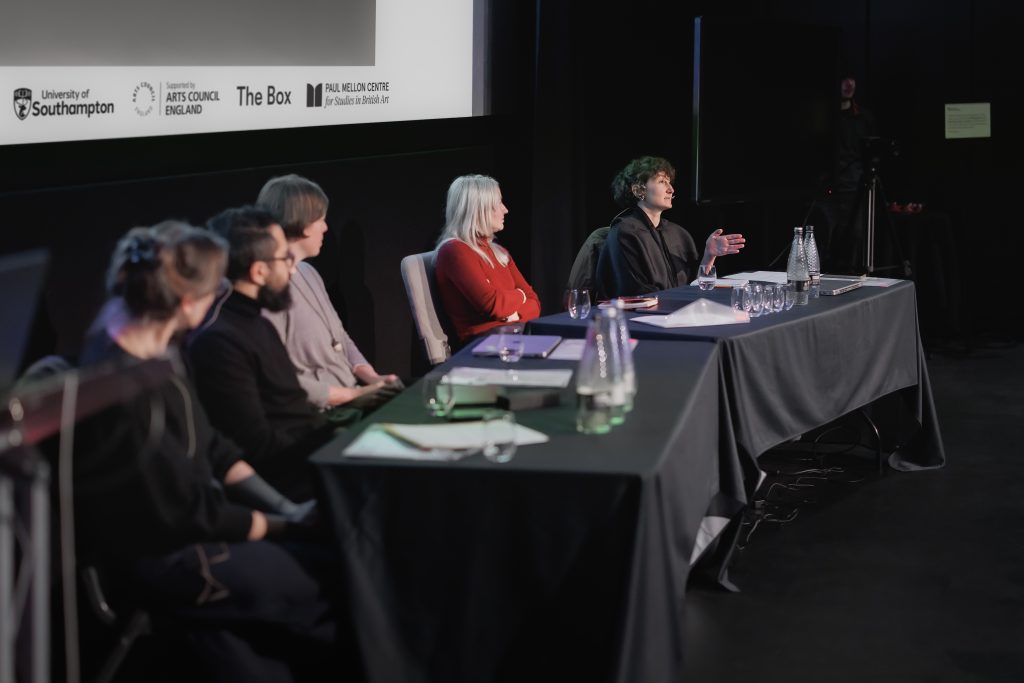
Whenever I have the enormous privilege to join a panel like this, with artists and media theorists and writers and digital theorists, I feel like such a lawyer, because I am a lawyer, and I worry about what I can add to these rich and creative perspectives from the arts and the humanities.
But when I saw that the theme of our panel was tyranny, I understood why the panel would want a lawyer – because lawyers and tyrants have a lot in common, but perhaps the biggest thing we have in common is that we love law. Tyrants love law. There are very few tyrants in history who governed with chaotic anarchy, no the first thing a tyrant does, or perhaps the second after gilding his palace, is create a legal system. Oppressive, tyrannical regimes are almost always legal regimes. Just as they adorn their hallways with portraits of themselves, tyrants adorn their autocracy with legal institutions and legal processes.

Why do tyrants love law? They love law because law is the malleable matter with which imagined worlds are built. Like words to an author or clay to a sculptor, law is a project of the imagination, it is the creativity-inspiring stuff to rub between your fingers and craft into something. But with law you do not make books or paintings or sculptures, you can make worlds. Law is the stuff with which we build our communities, shape our societies, construct our worldly relations.
Tyrants imagine a world – a world sliced into pieces, a world they control, a world they own, and use the law to create that world. As the Cameroonian historian Achille Mbembe shows us, the tyrannical imagination is excited by the legislative possibilities of pain and death.
But Tyrants also like law because it does not govern us individually, law governs us collectively, it deals with us aggregatively – quicker and more efficient when you have a population, maybe an empire, to control. Law decides who we are, puts us in a category and governs the category. Most important of those categories is the category of legal personhood itself – law wants to know (or decide) who counts as a person, and if they are a person, to decide what kind of person they are.
The tyrannical/colonial imagination delights at the idea of legal personhood and at the opportunity to examine us closely and decide what about us excludes us from being persons.
Law, as tool of tyranny, is concerned with the intimate details of our lives and our bodies, prying into our homes, scrutinising our relationships, counting our teeth, measuring our heads, peering into our underwear, examining where and how we live.
The point of that invasion is not to know us, but to categorise our bodies, to control the details our lives, relationships, and homes. Tyranny’s law exposes the most intimate aspects of ourselves so as to strip us of that intimacy, to decide what is lawful and what is deviant, to select what to protect and what to punish, to name us, to classify us, and to penalise us if we step out of category.
You are what law records on your birth certificate or your passport or your identity card, you are what law tattoos on your body.
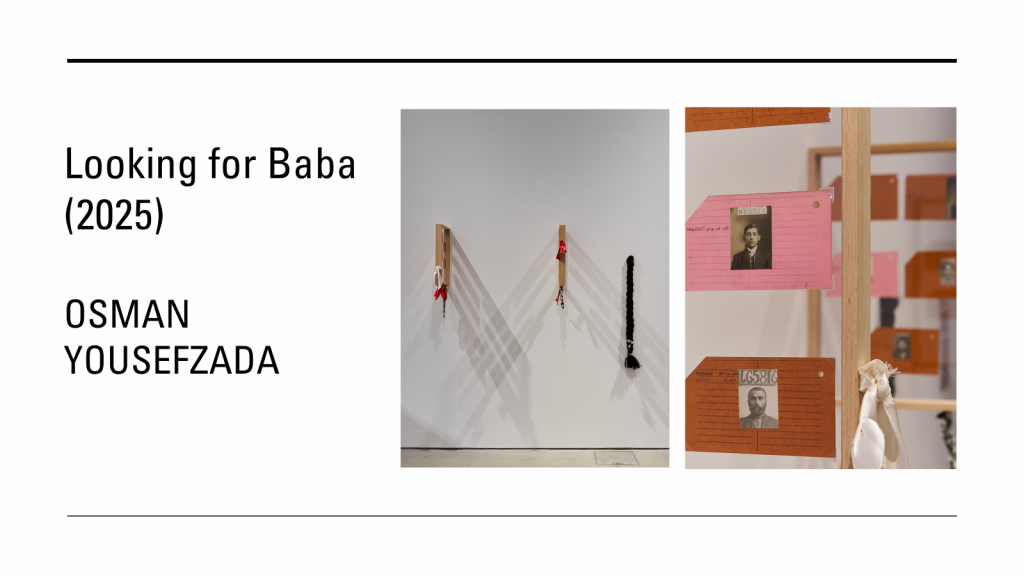
It is this that I think Osman Yousefzada’s artwork, looking for Baba, explores and uncovers. Looking for Baba features ten archival photographs of lascars, colonial Indian sailors, who served aboard P&O ships during both World Wars. Yousefzada discovered these images while he was exploring the Southampton Archives, where he was searching for traces of his lascar grandfather.
These small identify cards are surprisingly detailed. While much of the information they include is, presumably, to aid identification, some of it is not. The cards record (or fail to record) height, colour of hair and eyes, tattoo marks but also father’s (not mother’s) nationality.
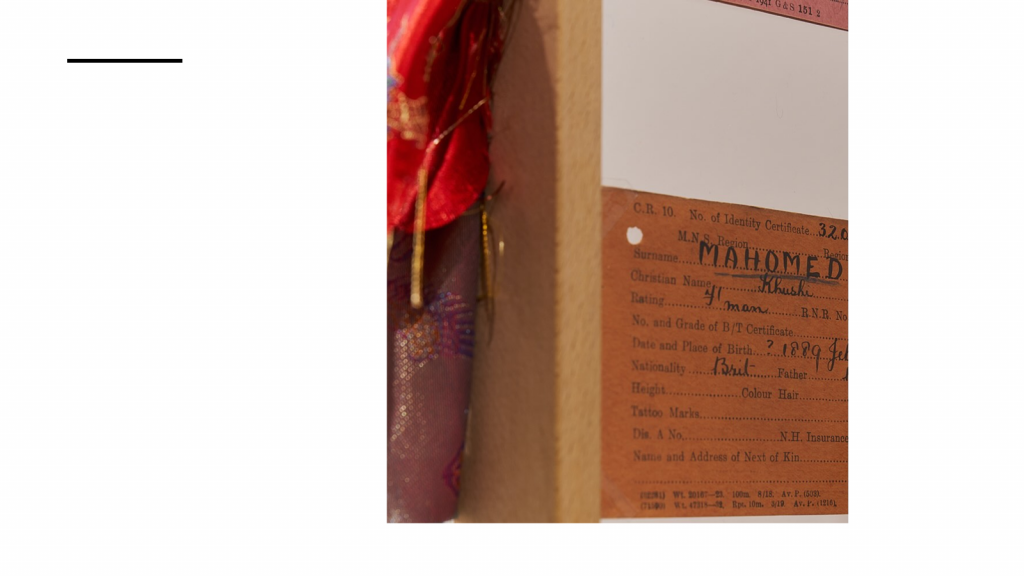
These cards are, in a sense, familiar to all of us. We all, to some degree, are obliged to hold the law’s markers of our identities, in passports and identity documents, in tiny rectangular photographs of our serious faces.
But for those governed by tyranny’s law – and it is of course worth emphasizing that in every legal system, some of us are governed through systems of justice and some of us are governed through systems of tyranny – these identity cards have a different resonance.
First, throughout colonial history and still today, they are not optional. For some, identification documents are a choice or a minor inconvenience on route to a holiday. For others, these documents are the mandatory pieces of paper that govern a person’s ability to move, work, have a home, and exist. Second, they are used not only to regulate movement, work and so on, but to differentiate and humiliate.
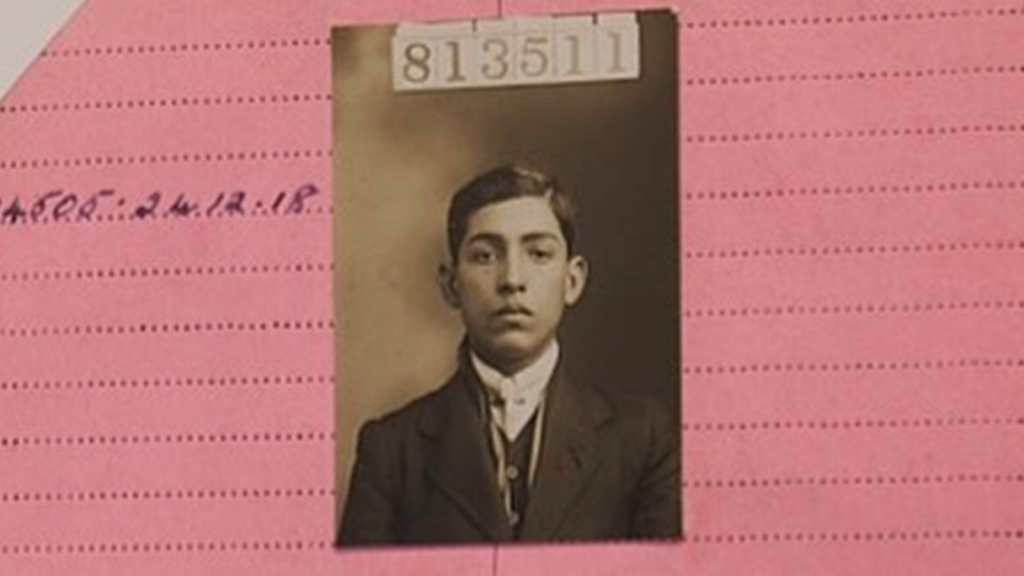
Third, and perhaps most importantly for thinking about the tincture of tyranny in intimacy, these documents are often the only markers of identity a person has. The oppressed are often denied the means to commission portraits or create albums of cosy family photographs, or the leisure to write letters and memoirs. Their ancestral objects are destroyed or stolen. When they die, the identity card is often all that is left.
And, as a result, these markers of identity continue to be the ways we know our ancestors and ourselves, as we search through the archives for our families and our own identities, we find identity cards, pass books, detailed descriptions of hair texture, eye colour, racial classification and so on. We live in a world imagined by tyrannical colonisers and made with law that continues to determine the most intimate details of our ancestral and our self-knowledge.
But, as the South African scholar, Hugo Ka Canham argues, we have to look at these identities askance. In his book Riotous Deathscapes, Canham has developed what he calls Mpondo Theory, an approach to, among other things, knowing oneself when so much of one’s self-knowledge has been rendered by colony and apartheid. Canham argues for the practice of ukwakumkanya which is the isiMpondo word for lifting one’s hand to shield one’s eyes. Canham says this is “Creating a shadow in order to illuminate… creating light by blocking the sun’s glare” – an approach to self-seeing beyond colonial and state sanctioned narratives.
And I think this is what the piece, Searching for Baba, does. In his assemblage of identity cards, manats in various fabrics tied around the frame, and the plaited hair, Yousefzada invites us to shield our eyes as we look at these identity cards, to block the glare and see beyond the colonial and the tyrannical.
This piece made me think of a practice of resistant of self-knowing that emerged in apartheid South Africa.
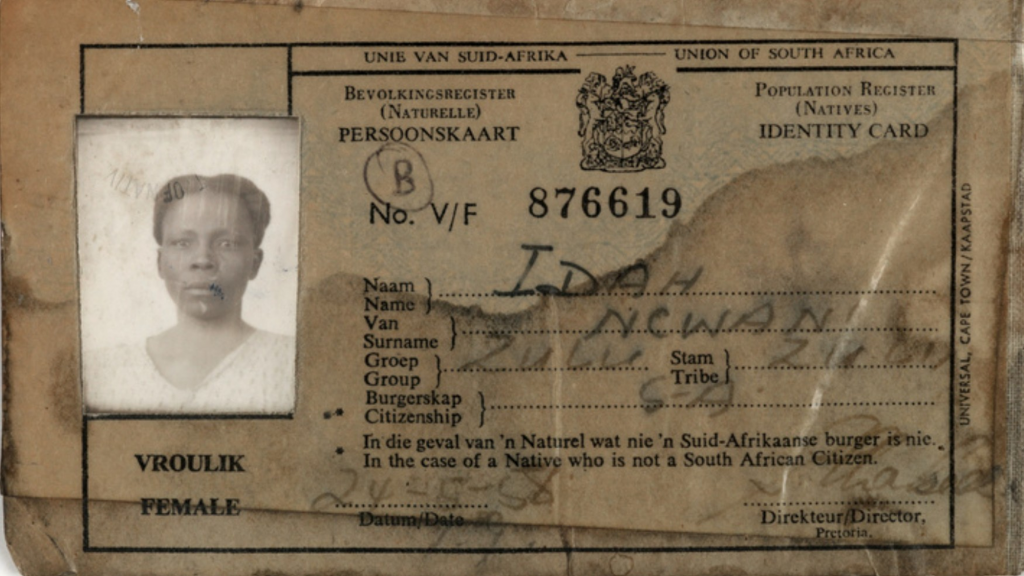
The dompass issued to black South Africans governed their every movement, their work, their right to live somewhere, a critical tool for implementing the apartheid legal regime and its commitment to separateness. And for many black South Africans, the photograph inside the dompass was the only image they had of themselves.
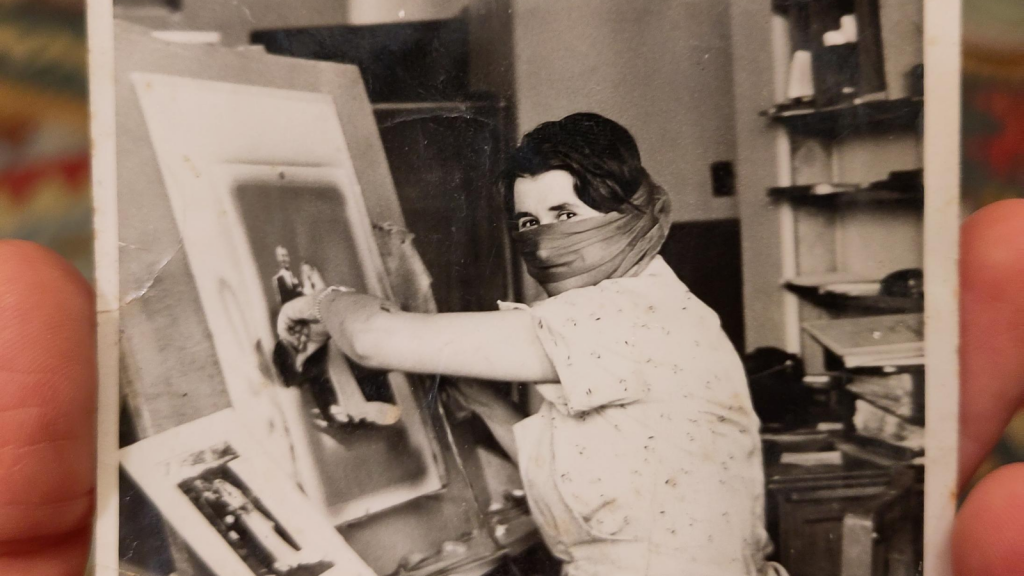
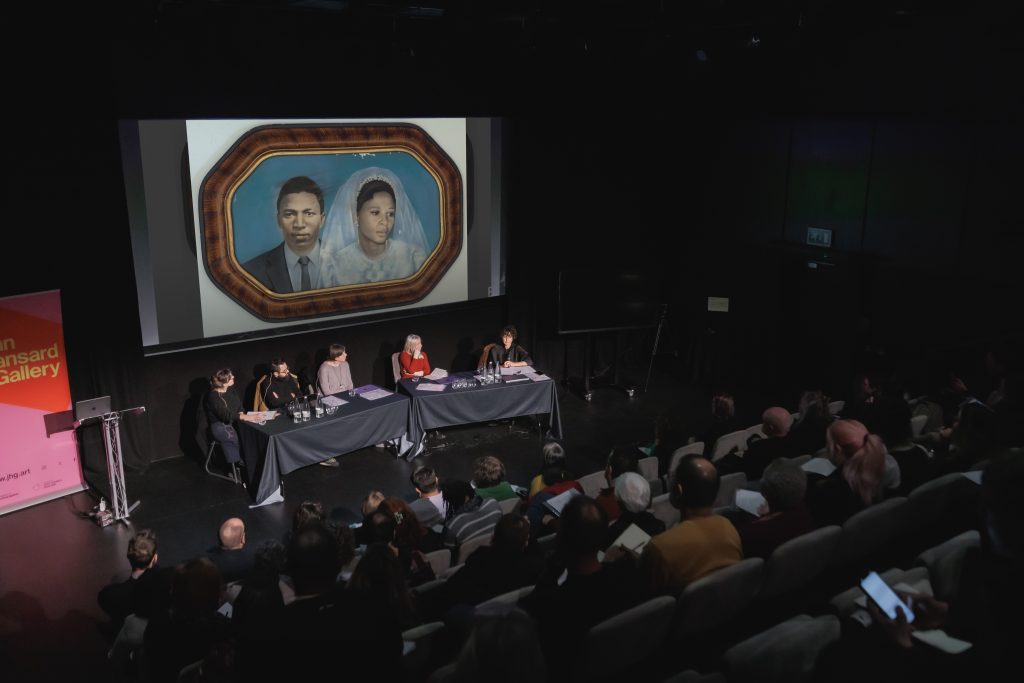
This is a picture of my great aunt, Yettie Saunderson, and she is one of the reasons I was so drawn to the Yousefzada’s searching for Baba. Yettie was an airbrush artist in Johannesburg and most of her work, starting in the 1950s and ending in the early 1990s, involved creating wedding portraits for couples compelled to live in a state of separation by apartheid and the migrant labour system.
These wedding portraits were created using two separate photographs, taken in entirely different contexts, and very often the images were taken from the dompass.
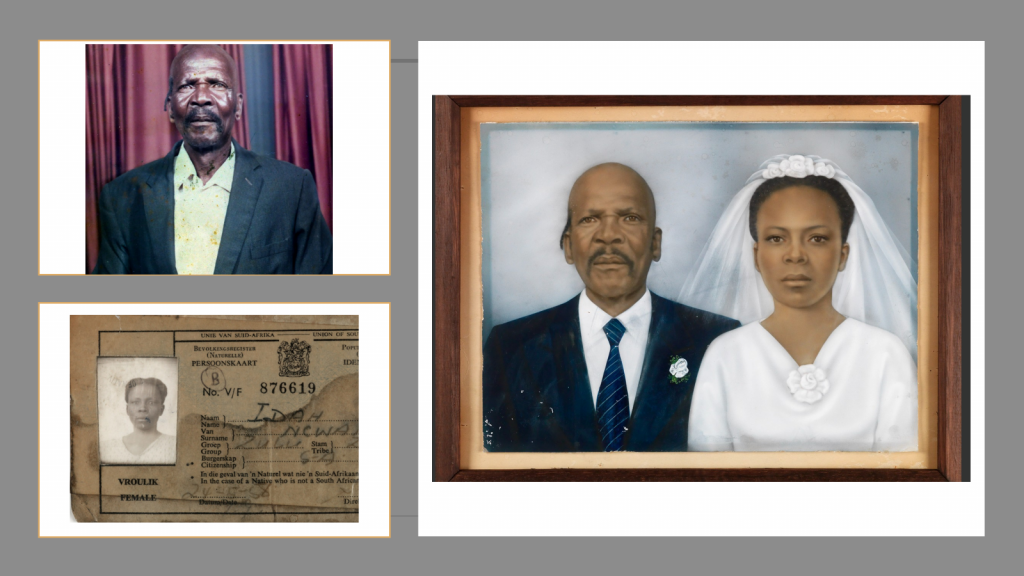
In a world imagined by tyrants, these couples imagined something different. As Ruth Sack has written, they gave couples a way of being seen together, indeed of “being” together, in one frame.
In reclaiming the intimate space, the couples in these pictures often also used law to bring their imagined worlds into being – these images became their own kind of legal document, as evidence of a wedding, a relationship, a family, a home, a love sometimes with significant legal implications including, for example, allowing a widow to keep her home.
And so I will end with this remark: While Tyrants use law to bring their imagined worlds into being, law – as a creative medium is not only available to tyrants, colonisers or states and the project of knowing ourselves and our ancestors is also a project of reimaging law, away from tyranny, shielding one’s eyes and looking askance at law’s intimacy.